Silicon Valley Byte Size - The Allianz Technology Trust Podcast
AI: hype, bubble or the next major tech cycle?
Watch the video
Listen to the podcast
Is artificial intelligence just the latest market obsession – or the start of the next major technology cycle?
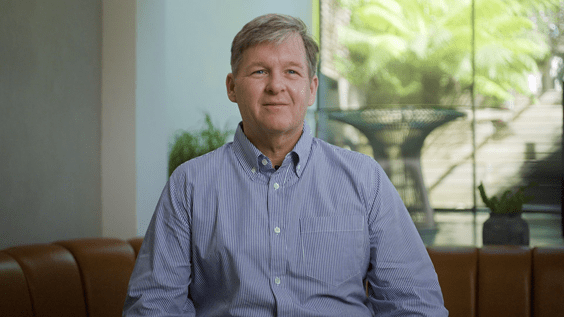
In the latest Allianz Technology Trust podcast, lead manager Mike Seidenberg joins Cherry Reynard to offer a clear, balanced perspective on AI investing. The discussion spans corporate adoption, software valuations, concentration risks and how ATT looks to capture long‑term opportunity beyond the headlines. Watch or listen now.
MS: Wall Street tends to shoot and ask questions later. and we're definitely seeing that in software. broad based. I mean, they're, you know, kind of a take no prisoners approach. I remind investors that, you know, you know, stocks don't go up in a straight line. And there's a lot of inherently, you know, Wall Street tends to get too excited and too upset. And in between, there's a lot of opportunities. But right now there is a serious worry, that every morning you wake up as a software holder and some AI company has decided that they can do what you do, you know, for fractions of the cost.
CR: Hi, I'm Cherry Reynard, and welcome to Silicon Valley byte size from Allianz Technology Trust, where we discuss, chew over and break down the biggest trends in tech investing.
CR: So where better to get things started than on the hot topic of artificial intelligence? Much has been said, read and heard about AI, but when it comes to investing, is AI just hype? Is it a bubble? Are we witnessing the next major shift in technology? I'm here with Mike Seidenberg, lead manager of the Allianz Technology Trust. Mike's been investing in tech long enough to have seen several major cycles unfold. So let's start with the basics. You've described technology as moving in big waves, from mainframes to client server to the internet to the cloud. Where does AI fit into all of this?
MS: AI appears to us to be one of those secular themes that occur every once, you know, 12 to 15 years. And the hardest part of our job is figuring out whether or not something is a niche or whether it's secular, because when it's secular, it tends to be, you know, very disruptive and very much a, a, a sea change event. And if I go back, you know, just in my own personal investing career, you know, I was around when client server, served, mainframe, I was around when internet, was birthed.
MS: I was around when cloud computing, became table stakes for companies. And AI has that feeling of another large secular theme that's emerging. and our job is to figure out the best way to monetize that for our investors.
CR: And, of course, social media was a big beneficiary of the internet. It changed the way we all communicate and consume media.
MS: Yeah, I mean, social media, you know, I think of that is, it's funny, I it's in that same genre of a secular theme in that it is the way, you know, we live in a digital world. I mean, if you just think about, you know, if you think about your day and you think about, you know, your interaction with digital devices. I mean, if someone had told you 15 years ago that, you know, you're going to basically live on this, you know, highly powered, phone in front of you, and basically runs your life, you know, you would have probably told them they were crazy.
MS: but, you know, I think the important thing about a digital world is it's really key for how companies interact with their customers as well. So, yeah, I mean, I think social media is in that same theme. It's probably a little more nichey, only because, you know, there are very few companies. But if we think about something like AI or think about cloud computing, it was pervasive across, you know, so many industries. and we're seeing that today.
CR: Yeah, absolutely. I mean, I wonder, can you talk a bit about what makes you confident that AI is in that category, and not just a kind of short term obsession?
MS: Well, I mean, one of the things that makes us incredibly confident about it is the, you know, literally hundreds of billions of dollars that are being spent to build out the infrastructure. You know, I think that, as I speak here today, OpenAI is closing, their funding round. I want to say $110 billion. I don't think it's finalised at a kind of a $730 billion valuation. And those numbers are just, you know, staggering, right? and if you saw the likes of, you know, the hyperscalers and what they're going to spend going forward on CapEx, I mean, it is, you know, I think the joke was one of them was, you know, equal to the, you know, economy of Kenya, for a single company. so, like, these are massive, massive spending projects and. Sure. Is there a risk it doesn't pan out? There is. But having said that, I mean, you know, what you're already seeing is the productivity gains, that the companies are seeing, whether that's those productivity gains are coming from knowledge workers. I mean, if I use my own example, like I've been really impressed with, we use office 365 and, you know, it has learned my lingua franca and how I speak and how I write. And it's really suggesting a lot of really, you know, robust and interesting words as I, as I write emails that are saving me time.
MS: You know, if you extrapolate that, you know, I think last night, XYZ, which used to be called square, talked about about a 40% reduction in headcount. And they're getting that headcount reduction vis-a-vis using AI. And whether, you know, coding, you know, automating tasks that people used to do. So look, you know, I think that the jury is still out, but the early data suggests that this is going to be productivity enhancing. Look, there's a there's a there's a downside to that, which is there's going to be jobs that they probably are lost and people are going to have to be repurposed. but I you know, I do think that, you know, it is the, you know, it is the wave of the future. people aren't going to go back. and that kind of forces us as investors to figure out, you know, ways to invest in it.
CR: Okay. So the sign that it's really is, is really that it's embedding itself into, you know, daily operations for businesses.
MS: Yeah. I mean, I think that, you know, and here again, I just caution investors it's early still, you know, you know, we are still in the early days. But you know, just some of the stuff we're seeing is really saving time. It's making, you know, if I use, you know, the coding example for, for software developers, you know, the ability to create code to create, you know, applications and services. it, you know, it's very productivity enhancing, you know, I think that for knowledge workers. I mean, I'll give you an example. My coworker, you know, for conference calls, he used a piece of AI technology to basically summarise, what a conference call is saying. And, look, you know, I, I'm, I'm old school and that, you know, for our positions, obviously, I want to hear the conference call. I want to hear management. But for a company where we're kind of ramping up on, it's a great tool. Like the thing he developed. And by the way, he's not a coder like he developed it, you know, over like a course of a few days and, you know, prompted with questions and yada yada yada. And I've looked at it and it's really robust. I mean, it's impressive, you know, to see a technology be that enhancing, from a job perspective.
CR: And I mean, you mentioned software that I mean, what's interesting is that while AI stocks have surged, part of the software sector has sold off really sharply.
MS: Broad based.
CR: Yeah. You've pointed out that valuations were around 20 times forward EV to sales during the pandemic, and they're closer to five times now. I mean that's quite that feels quite dramatic. Why is there that sort of.
MS: Organic to me as an investment in space as well I might say. Yeah. I mean, you know, unfortunately, you know, Wall Street tends to shoot and ask questions later. and we're definitely seeing that in software. broad based. I mean, they're, you know, kind of a take no prisoners approach. and, you know, do I think that every company will be a victim of artificial intelligence? I don't I think workflows are really valuable. I think that corporate America depends on a series of checks and balances. and that's workflow, right? I mean, if you're a security company, if there is, if there happens to be a breach, it's not just about mitigating the breach. Right. It's about a series of events that codify and making sure that, you know, we've basically created a whole kind of dossier around that event. so I don't think that stuff is going away. I will tell you. There will be companies that are, you know, that suffer from artificial intelligence and that might show up in the in the likes of, you know, slower seat growth, at looking forward. And we've already kind of seen some hints at that. but right now, you know, the bar is high, to invest in software, given what we've seen, this broad based sell off and even companies that are reporting, you know, kind of solid quarters, they're not really being rewarded.
MS: I mean, fortunately for us, you know, we we've really spent a lot of time outside of software, the past year. but, you know, we're looking at the space, and, you know, at some point, you know, things become too cheap. but it's been it's been it's been a really tough space thus far.
CR: And how. How are you making that decision as to when to step in versus when you wait? And it could get worse?
MS: Yeah. I mean, ultimately every decision we make is based on risk reward. So we're kind of looking at the valuations, looking at the inputs to kind of, you know, kind of help us decide whether or not, you know, this company has the ability to to grow and if they can grow profitably, profitably, etc., etc.. so, you know, we use our same framework, but, you know, with respect to underwriting these businesses, you know, I the underwriting will be a lot more cautious going forward than something maybe we would have seen, you know, 2 or 3 years ago. I do think that artificial intelligence, you know, just the, the, the hangover on software right now is, is a pretty big cloud. So I want to make sure that if we're going to establish a new position, we really think about what do we think is fair value. And that fair value needs to reflect, the current environment, because ultimately that's kind of your appreciation. you know, your, your appreciation opportunity. and look, you know, I've also done the job long enough to know that things come in and out of favor. But right now, there is a serious worry, that every morning you wake up as a software holder and some AI company has decided that they can do what you do, you know, for fractions of the cost. and that, that, that, that is clearly impacting the group.
CR: Yeah, absolutely. now, one of the, one of the issues with AI has been that tech indices are heavily concentrated in just like a handful of names. I mean, how do you express conviction in AI with that without taking that sort of dangerous single stock risk.
MS: Yeah, we're very cognisant of single stock risk. And if you take a look at, you know, what we're kind of measured against it has a has some really high percentage rates of single stocks. You know our idea or what we've done traditionally as an organization as a team when we when we when we see these secular themes is really to try to figure out what I call the first and second derivatives. Right. So it's to really look at the entire ecosystem. And if, you know, for example, if GPUs, which you know, are primarily made by the likes of, you know, in, in Nvidia AMD, etc., etc., if they're, if they're being, if they're being deployed widely, what else needs to go in that equation? Right. you know, what else goes inside of that data center? and, you know, our job is to figure out, you know, various components or are various companies that are benefiting from that theme.
MS: In addition to obviously, you know, the the core companies, and, you know, we've done that just kind of time and time again. is really thinking through just what I would call, you know, the food chain associated with a particular, secular theme.
CR: Mike, you've talked in the past about so-called picks and shovels. I wonder if you could talk a little bit about what you mean by that?
MS: Yeah. basically, as opposed to trying to figure out the 4 or 5 AI platforms that are going to win or lose. And obviously, you know, there's a lot of inherent risk in that. Sometimes it makes sense just to own the components, the essential components that go inside of those solutions. So whether that's semiconductors, whether that's semiconductor equipment, you know, connectors inside data centers, power management systems. from our perspective, this tends to be a really robust way to play an emerging theme.
CR: So, AI may well be the next major technology cycle, but as always, the opportunity comes with volatility, valuation swings, and the need for discipline.
CR: any final thoughts, Mike?
MS: Yeah. I mean, look, I remind investors that, you know, stocks don't go up in a straight line. And there's a lot of inherently, you know, Wall Street tends to get too excited and too upset. And in between there's a lot of opportunities. So, our job is to figure out how to perform over our long term basis. And, you know, the portfolio is run in such a manner that we want to create value for our shareholders over a multi-year time period. So if you're looking for, you know, quarterly performance and if you want to, you know, expect us to, you know, outperform every quarter. And you know, you want to, you know, whatever Trade. Trade. Trust. I personally don't think we're the best, you know, vehicle for that. If you're looking for durability in a long term track record. You know that's something we've delivered on and something we hope to do in the future.
CR: Okay. Great. Thank you so much, Mike, for joining us today.
MS: Great to see you.
CR: Now if you would like to find out more about the Allianz Technology Trust and how it's positioned across AI and other long term themes, you can visit the Allianz Technology Trust website for full details. Thanks so much for joining us.